Saturday, December 8, 2012

Solar System: Related Topic - The Big Bang


How was the Universe made?


Most of the satronomers think that the Universe was formed during an even called “BIG BANG” – a giant explosion which occurred between 10 to 20 billion years ago. During the Big Bang all of  the space, time, matter and energy in the Universe was created. This giant explosion hurled matter in all directions and caused space itself to expand. As the universe cooled, the material in it combined to form galaxies, stars and planets.


Planets


Galaxy
Stars


Solar System : Related Topic - The Universe


Related Topic – The Universe


      The Universe is made up of billions of galaxies. In the Universe, there are 2,000,000,000,000,0000,000 stars. These stars made up galaxies. Each galaxy has a billion of stars. The Universe is incredibly huge. It would take a modern jet fighter more than a million years to reach the nearest star to the sun. Travelling at the speed of light (300,000km per second), it would take 100,000 years to cross our Milky Way galaxy alone.

        No one knows the exact size of the Universe, because we cannot see the edge. All we do know is that the visible Universe is at least 93 billion light years across (A light year is the distance light travels in one year – about 9 trillion km).


Wednesday, December 5, 2012

Solar System: Related topic - Galaxy

Solar System: Related topic - Galaxy: The Galaxy The  Universe  is estimated to contain 200 billion galaxies.       There are various kinds of galaxie...

Monday, December 3, 2012

Comet - Another member of Solar System

Comet - Another member of Solar System.

What is a comet?

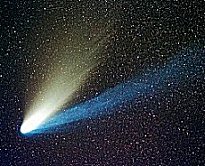
Comets are basically dusty snowballs which orbit the sun. They are made of ices, such as water, carbon dioxide, ammonia and methane, mixed with dust. These materials came from the time when the solar system was formed. Comets have an icy center (nucleus) surrounded by a large cloud of gas and dust (called the coma). The coma is created as the ice in the nucleus is warmed by the sun and vaporizes. Comets can develop 2 tails as they travel closer to the sun, a straight gas tail and a curved dust tail. The gas tail is created by the solar wind, whose magnetic fields pull the gas away from the comet's coma. The dust in the coma is not affected by magnetic fields but is vaporized by the sun's heat, and forms a curved tail which follows the comet's orbit.


Monday, November 26, 2012

Another member of Solar System - Asteroid


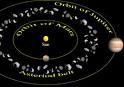
The asteroid belt lies between the planets Mars and Jupiter. It contains lumps of rock and metal much smaller than planets. These lumps are called asteroids or minor planets. Asteroid like other planets moves around the sun in its band area. They are not visible from Earth with the naked eye, but many may be seen through binoculars or small telescopes.

Wednesday, November 7, 2012

The Orther Member Of Solar System-The Natural Satellite


Natural Satellites

     A natural satellite is a celestial body ( planet) that moves around another bigger planet . A natural satellite does not give out light . For example , the Moon is a natural satellite of Earth . With the exception of Mercury and Venus , all the other planet in the Solar System have natural satellites . Mars has two natural satellites namely Phobos and Deimos . Big planets have more natural satellites . For examples , Jupiter and Saturn have 62 and 31 natural satellites respectively . Io and Europa are natural satellites of Jupiter and they are of the same size as our Moon . Another two natural satellites are Ganymede and Callisto . They are bigger than our Moon and are as big as Mercury . Among the natural satellites of Saturn, Titan is the biggest and is 1.5 times the size of our Moon . Uranus and Neptune have 24 and 13 natural satellite respectively . The biggest natural satellite of Neptune is called Triton.


The other members of the Solar System


Meteor

    When the weather is fine at night , we can see many stars twinkling in the sky . Once in a while we can see a bright ray of light shooting across the sky and then disappears in an instant . Some people think that the stars have fallen to the fallen ? Of course not ! The ray of light is a meteor or a shooting star .
    A meteor is meteoroid that burns in a bright streak due to great friction with the air molecules in the atmosphere . What is a meteoroid ? A meteoroid is a small piece of rock that floats about in space . In the Solar System, there are millions of meteoroids that move around the Sun . Meteoroids move close to the Earth . The force of Earth’s gravity pulls some meteoroids into the Earth’s atmosphere . Most meteoroids burn up into ashes in the atmosphere before they can reach the surface of the Earth . Sometimes some meteoroids that are not burn up completely do reach the surface of the Earth and these are known as meteorites .
    Sometimes many meteors can be seen falling from the sky . This is known as a meteor shower .